The Virtue of Fasting During Muharram Abu Al-Hasan Malik Al-Akhdar
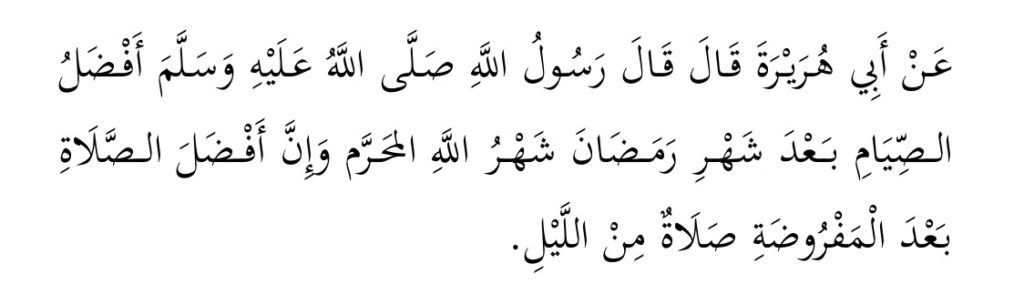
Abu Hurayrah reported that the Messenger of Allah (ﷺ) said, “The best month for observing siyam after Ramadan is Al-Muharram, and the best prayer after the prescribed salah is prayer at night.”[1]
This narration clarifies that Muharram is the best month for fasting after Ramadan. Yet, this raises a question: If that is the case, why did the Prophet (ﷺ) fast more during Sha’ban?
Al-‘Allamah Al-Azim Abadi (رَحِمَهُ الله) stated, “As for why the Prophet (ﷺ) fasted more during Sha’ban than in Muharram, there are two possible explanations: First, he might have learned of the virtue of [of fasting in] Muharram later in his life. Second, he might have had excuses such as travel, illness, or other reasons [during Muharram].”[2]
Further, Al-‘Allamah Muhammad b. Salih Al-‘Uthaymin (رَحِمَهُ الله) said,
It has been said that the best month to fast [after Ramadan] is Muharram, but this needs further consideration since the Prophet (ﷺ) used to fast more in Sha’ban than in Muharram.
Another interpretation is that “the best month for observing siyam” means fasting the entire month, but this, too, requires scrutiny because ‘Aishah, who was one of the most knowledgeable people about the Prophet’s practices, said, “I never saw him fast more in any month than in Sha’ban.”
There is a third possibility that it means to fast in Muharram, not the entire month, unlike Sha’ban. This would mean that the Prophet’s action[3] clarifies his statement[4]. This interpretation seems the most accurate to me.
Some have said that the best month for fasting after Ramadan refers to fasting on the day of ‘Ashura, using a part to represent the whole, but this is also questionable because mentioning the entire month while only referring to one day seems unlikely.
The most accurate interpretation, and Allah knows best, is that Muharram is the best month for fasting [after Ramadan], aligning with both the verbal and practical Sunnah, without fasting the entire month or most of it.[5]
In sum, while the Prophet (ﷺ) stated that Muharram is the best month for observing siyam after Ramadan, he fasted more during Sha’ban. This suggests that fasting in Muharram is best, but not the entire month, aligning with his practice. Therefore, one should take advantage of fasting during Muharram, especially on ‘Ashura. Allah knows best.
[1] Collected by Muslim in his Sahih (no. (no. 1163) and Abu Dawud in his Sunan (no. 2429).
[3] I.e., his act of fasting most or all of Sha’ban.
[4] I.e., his statement that Muharram is the best month to fast after Ramadan.
[5] Muhammad Al-Uthaymin, *Sharh Kitab Al-Siyam wa Al-Itikaf*, accessed July 5, 2024, https://www.alathar.net/home/esound/index.php?op=codevi&coid=110444.
The Misguided Methodology of Al-Muwazanat Abu Al-Hasan Malik Al-Akhdar
The dangers of counterbalancing good and bad deeds in criticism (Al-Muwazanat) are clear and grave. This methodology stems from those who feel the need to praise innovators and transgressors as they criticize them. Their approach contradicts the way and the works of the people of Hadith, not to mention sound reasoning. The purpose of condemning such individuals and sects is to protect others from their harm. Counterbalancing criticism tempers its impact. Thus, no one mentions the beauty of a fire’s flames while urging people to flee a burning house.
When proponents of this methodology emerged, scholars of the Sunnah, led by Al-Allamah, Rabi’ b. Hadi Al-Madkhali confronted them and, by Allah’s permission, put them on their heels. Observing recent attempts by some to credit the people of innovation (and even some disbelievers) while criticizing Salafis, I chose to translate a brief reminder from our noble Shaykh on the falsehood of Al-Muwazanat. May Allah keep us firm upon the Sunnah, and may He reward and preserve the Shaykh.
***
Al-‘Allamah Rabi’ Al-Madkhali said, “To finish answering the previous questions, I believe one was about the methodology of counterbalancing good and bad deeds in criticism (Al-Muwazanat). On this topic, I have written two books, praise be to Allah: Manhaj Ahl Al-Sunnah wa Al-Jama’ah fi Naqd Al-Rijal wa Al-Kutub wa Al-Tawaif (The Methodology of Ahl Al-Sunnah wa Al-Jama’ah in Criticizing Individuals, Books, and Sects) and Al-Mahajjah Al-Bayda’ fi Himayah Al-Sunnah al-Gharra’ ‘an Zaygh Ahl Al-Ahwa’ wa Zallat Ahl al-Akhta (The Clear Path in Protecting the Noble Sunnah from the Deviations of the People of Desires and the Mistakes of the People of Errors).
I followed these two books with many responses to [‘Abd Al-Rahman] ‘Abd al-Khaliq’s doubts and fabrications in my book, Al-Nasr Al-Aziz ‘ala Al-Radd Al-Wajiz (The Great Victory over the Concise Rebuttal).
We have answered many questions on this topic. I first refer readers to these books I mentioned, so they can understand the evidence and principles upon which the Salafi methodology is based, which show the falsehood of this misguided and innovated methodology. I consider it one of the most despicable, deceitful, and dangerous innovations. If this methodology were truly adopted, it would destroy the Qur’an, the Sunnah, and all Islamic sciences—nay, all human sciences. Allah forbid. This approach, and Allah knows best, was invented by the people of falsehood to defend the people of innovation and misguidance. So, remember the lectures of deceivers and liars. I suspect those who formulated this methodology belong to this group, and I believe they were not preceded in this. I’ll suffice with a few examples for you:
In Al-Bukhari’s book Al-Du’afa (The Weak Narrators): Why did he not mention the good deeds of the men he listed in this work? By their logic and their principle, Al-Bukhari would be considered unjust, sinful, and lacking integrity. Thus, we should accept nothing from him.
Ahmad b. Hanbal spoke about hundreds of narrators without counterbalancing criticism, as did Yahya b. Ma’in, ‘Abd al-Rahman b. Mahdi, ‘Ali b. al-Madini, Al-Bukhari, Muslim, Al-Tirmidhi, Ibn Majah, Al-Daraqutni, Ibn Hibban, and Ibn Khuzaymah. They disparaged narrators without such counterbalancing and authored works on this subject, including those we mentioned: Al-Bukhari’s Al-Du’afa (The Weak Narrators), al-Nasa’i’s Al-Du’afa wa Al-Matrukin (The Weak and Abandoned Narrators), Al-’Uqayli’s KitabAl-Du’afa, and Ibn Hibban’s Kitab Al-Majruhin (The Book of the Discredited Narrators). Read these works. Do you find this methodology in them?
Then they cling to Al-Dhahabi, the historian. As a historian, he may occasionally show leniency, but he never follows the methodology they claim. In writing biographies, he might criticize a narrator and mention his good qualities as well. He also authored specific books dedicated to criticism, such as Al-Mizan, Al-Diwan, Al-Mughni, and Al-Dhayl. These four books are all focused on criticism. Why are they not mentioned? Why do they not refer to this Al-Dhahabi, whom they cling to as a historian in his book Al-Siyar? These are people of falsehood and doubts, and Allah’s statement applies to them:
‘As for those in whose hearts is deviation [from truth], they will follow that of it which is unspecific, seeking discord and seeking an interpretation [suitable to them]’ (Ali ‘Imran 3:7).
When they come to the Book of Allah, they interpret it as they wish. When they come to the words of the Messenger, they interpret them as they wish. When they come to the words of the scholars of the Salaf, they interpret them as they wish and distort them. We have not seen an innovation more dangerous than this methodology, nor innovators more dangerous to Islam than these. They only defend falsehood and misguided beliefs. When you bring up someone who insults the Companions or the Prophets, they ask, ‘Where are his good deeds?’ But when they mention the people of Sunnah, who are full of good deeds, they do not mention any of their noble qualities and fabricate faults. How similar they are to the Rafidah.
May Allah bless you. I will stop here, and I urge you to refer to the books I mentioned, which have been endorsed by the scholars, praise be to Allah, including Ibn Baz, Al-Albani, Al-‘Uthaymin, and others. Some of those who initially authored these works later retracted and acknowledged that when criticism is meant for advising and warning, it is not necessary to mention good qualities. One of them cited consensus on this matter. I only criticized the people of innovation and misguidance to offer advice and warnings. So why do they attack me and my books? May Allah bless you.”[1]